The day of Moon
October 12, 2025
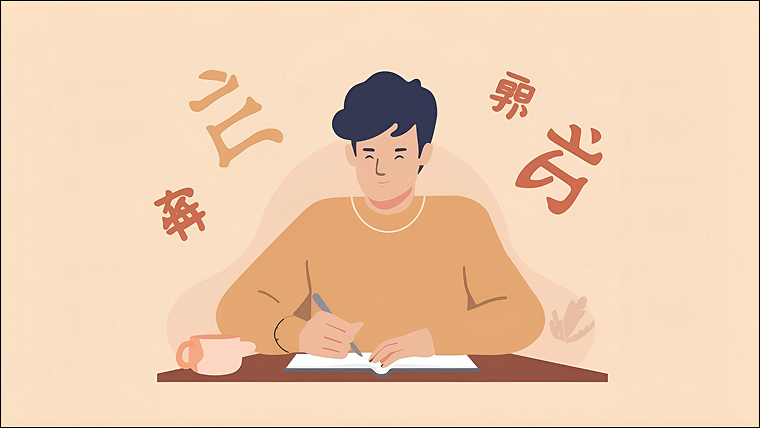
When I began learning Japanese a few months ago, I honestly thought it was going to be brutal. I’d admired the language and the culture for years, but I always held back because I assumed it would be too complicated or too time-consuming. It felt like one of those things you admire from a distance without ever expecting yourself to actually do. It took me a while to finally muster the courage to give it a real try.
Then I started.
And what I found wasn’t pain at all. It was calm. It was focus. It felt like a form of meditation that happened to involve a notebook, a pen, and the steady rhythm of new sounds. Japanese has this surprising clarity to it, a kind of economy in how ideas are expressed. Once the basics clicked, everything that looked intimidating from the outside became enjoyable puzzles on the inside.
Learning it has made me more disciplined, more patient, and even sharper as a software developer. I can express ideas more clearly. I think more slowly and intentionally. And I’ve opened a whole new path for myself that I never expected.
I went in expecting frustration, but the more I studied, the more the language opened up in small, surprising ways. Simple patterns started forming. Grammar stopped looking like a wall and more like a set of tools I could actually use. Even kanji, which used to look like an impossible script, became something I looked forward to practicing.
And somewhere in that process, the fear I had at the beginning quietly disappeared. I just found myself enjoying it.
As I kept studying, I realized that one of the reasons Japanese feels so rewarding early on is the way the language is built. Everything is layered in a way that helps you make real progress from day one, even before you understand much grammar (not to mention how many things you can already say with just a single verb).
Let’s take a quick look at the fascinating building blocks that make up Japanese — the scripts, grammar, and key patterns that give the language its shape. Once you see how it all fits together, you’ll realize that getting started isn’t as intimidating as it seems.
Hiragana: The First Door You Walk Through
Hiragana is the simplest script in Japanese, but also one of the most brilliant teaching tools I’ve seen. The characters look soft and curved, almost deceptively cute (because you’ll confuse them a lot at first — at least I did!), but learning them flips a switch: suddenly you can read children’s books, basic sentences, and even menus or street signs. For beginners, it’s a rare early chance to interact with the language in its native form — no romanization, no training wheels.
Being able to read hiragana changes your mindset. You stop feeling like an outsider peeking into a complicated system and start grappling with real words, sounds, and patterns. For me, mastering it wasn’t just a first step — it was proof that progress in Japanese comes from small, meaningful openings, not pain or difficulty.
Once I got comfortable with reading hiragana, the next thing that surprised me was the sound system. Compared to Persian and English (languages I already know), Japanese sounds are remarkably simple and consistent. Even now, knowing only a few words, I can usually recognize what’s being said without getting tripped up by unpredictable pronunciation like in English.
Part of that simplicity comes from how efficiently Japanese packs meaning into short expressions. The tongue doesn’t have to twist in ten different directions for each word. Compared to Persian and English, this economy of speech feels almost like a superpower — simple sounds carrying a lot of meaning, cleanly and clearly.
Katakana: The Script for the “Foreign”
Katakana usually comes next, once you’ve practiced the basics with hiragana. At first, it feels a little unusual to have multiple scripts doing the same job — and we haven’t even touched on kanji yet, the one that truly scares most learners.
In practice, katakana is mostly used for foreign words, names, and borrowed terms. It’s less about complex grammar or meaning and more about reading things as they’re pronounced in Japanese. Learning it adds another layer to your reading skills and opens up the ability to recognize words from menus, signs, and pop culture references that hiragana alone can’t cover.
Kanji: The tip of the mountain
Kanji has a reputation for being the scariest part of learning Japanese — and for good reason. At first, the sheer number of characters and their complexity can feel overwhelming. But once you start learning them, it’s surprisingly fun. Many of the fears you had before — the “impossible” complexity, the memorization nightmares — quickly fade as you discover patterns and meanings. What once seemed intimidating becomes another puzzle to enjoy.
One could argue that because kanji began as logographic signs — early pictorial characters carved for divination and record-keeping — they preserve ways of seeing that belonged to earlier generations. Studying kanji etymology and form can give learners a small window into historical metaphors, practices, and priorities. It’s a plausible hypothesis worth exploring, not an established fact. For me, though, it’s a fun game of imagination — one that makes my fondness for the language grow even more. In that sense, studying kanji often feels a little like time travel.
This “time-travel effect” also shows up in very practical ways:
It gives learners a mnemonic hook. It’s easier to remember 休 (rest) when you see it as a person (亻) leaning against a tree (木).
It offers a deeper connection. You’re not just memorizing a shape for “rest”; you’re accessing a tiny, 3,000-year-old metaphor for what rest looked like to the people who first created it.
It acknowledges the logographic origin. Early characters truly were pictographs — simple forms like 山 (mountain) or 川 (river) still show their ancient silhouettes.
That blend of history, imagination, and practicality is what makes kanji so captivating for me.
Now, What’s the Point of Three Scripts?
At first, juggling three scripts felt… unnecessary. But each has a role, and together they create something elegant:
Hiragana: Handles the grammar and glue of sentences — particles, verb endings, and the subtle connections that hold ideas together.
Kanji: Carries meaning, condensing whole concepts into single characters and giving sentences depth and clarity.
Katakana: Mostly for foreign words, names, and borrowed terms, signaling “this is from outside” while fitting seamlessly into the flow of Japanese.
Because these roles are so distinct, Japanese can guide the reader without relying heavily on spaces or standard punctuation. Small marks, line breaks, and the natural flow between scripts do the job, keeping sentences clear and readable. What seems complicated at first is actually a clever system — functional, precise, and surprisingly fun.
I was just completely blown away by how much it all made sense and how these seemingly different pieces worked hand in hand to make reading in Japanese a novel experience.
My Baby Steps
After getting familiar with hiragana, katakana, and kanji, I decided to take the next step and try private tuition classes. I was terrified at the thought of writing with pen and paper again — after years of staring at screens all day as an online teacher and software developer, I worried I wouldn’t adjust.
But it turned out to be exactly the change of pace I needed. Writing by hand and practicing in a real notebook brought a surprising clarity and energy I hadn’t felt in years. Being a Japanese student in this way lets me learn and practice without relying on a screen, giving each character, sentence, and sound a real, tangible presence.
Then, in one of the sessions, I was asked by my sensei, “Kyo wa nanji desu ka? (What day is it in?)” I didn’t get it on the first try and had to pause for a moment — but suddenly, it clicked: “kyo wa getsuyoubi desu(Today is the day of Moon!)” (which is how you say Monday in Japanese!).
That tiny sentence — “Today is the day of Moon!” — felt like a real breakthrough. It reminded me how powerful classroom guidance can be in building confidence and getting the basics right. At the same time, I realized that freely available resources are a perfect way to reinforce and expand what you learn in class.
For example, Duolingo is really not as bad as people say, but it can become a negative influence if you don’t approach it with the right perspective. Jisho is a solid dictionary, but Japandict also deserves a shout-out since it offers a bigger database for certain kanji. In a future blog post, I’ll rank and explain how best to utilize each in detail.
Go for It — Japanese Is Worth the Journey
Learning Japanese is one of the most rewarding challenges I’ve ever taken on. It’s demanding, yes — it will take years of commitment and consistency to feel truly comfortable. But what you gain along the way is unmatched: the joy of surprising yourself, proving the doubts in your head wrong, and discovering a language that’s both elegant and practical in ways you never expected.
Every step, from mastering the scripts to forming your first sentences, introduces delicate concepts that slowly transform the way you think and express yourself. Before long, studying Japanese doesn’t feel like work — it becomes one of the most enjoyable, engaging activities in your life.
I want to invite you to take on this challenge. The voice in your head might be underestimating what you can do, but with patience, curiosity, and persistence, you’ll be amazed at how much progress you can make. Keep learning, keep practicing, and don’t be afraid to make mistakes — each small step adds up to something extraordinary.
I feel truly humbled to be experiencing this journey again through Japanese, and I hope you take the chance to begin your own language adventure. If you have any questions or want guidance along the way, I’m available on various social media platforms and would love to help.
Good luck, and happy learning!